
Research
Overview
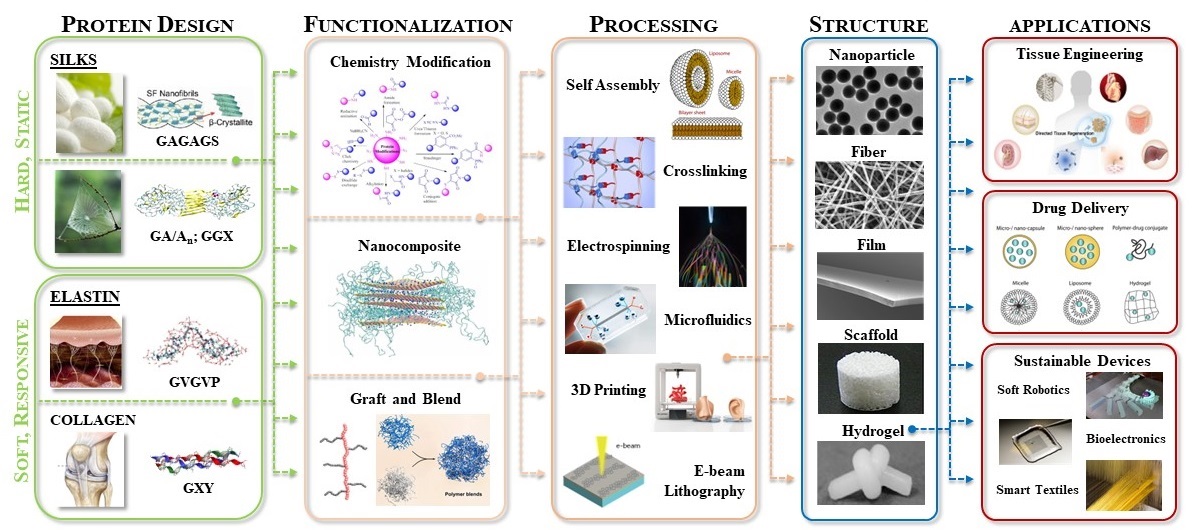
Our research interests lie at the intersection of synthetic biology, biophysics, materials science, and biomedical engineering. Specifically, we focus on the predictive design, synthesis, and functionalization of fibrous proteins, including silk, elastin, collagen, and keratin, for the development of de novo designed stimuli-responsive and hierarchical biomaterials. These studies encompass a broad range of topics, including fundamental investigation related to semi-crystalline polymer phase transitions, protein structure-function relationships, self-assembly mechanisms, as well as applied biomaterial studies related to drug delivery, tissue engineering, surface coating, responsive bio-actuator, and bio-electronics.
(1) Smart Material Design
– Development of protein-based biomaterials with pre-designed stimuli-responsive features for soft robotics
The increasing demands of advanced healthcare have driven innovations in numerous functional biodevices. While many synthetic polymers demonstrated initial success for multiple clinical-related challenges, such as electronic skins, implantable devices, biosensors, and adaptive shape memory materials, protein-based smart materials are still in high demand for biomedical applications, due to their exquisite sequence control and thus precise chemistry, along with tunable mechanical properties, biocompatibility, and biodegradability.
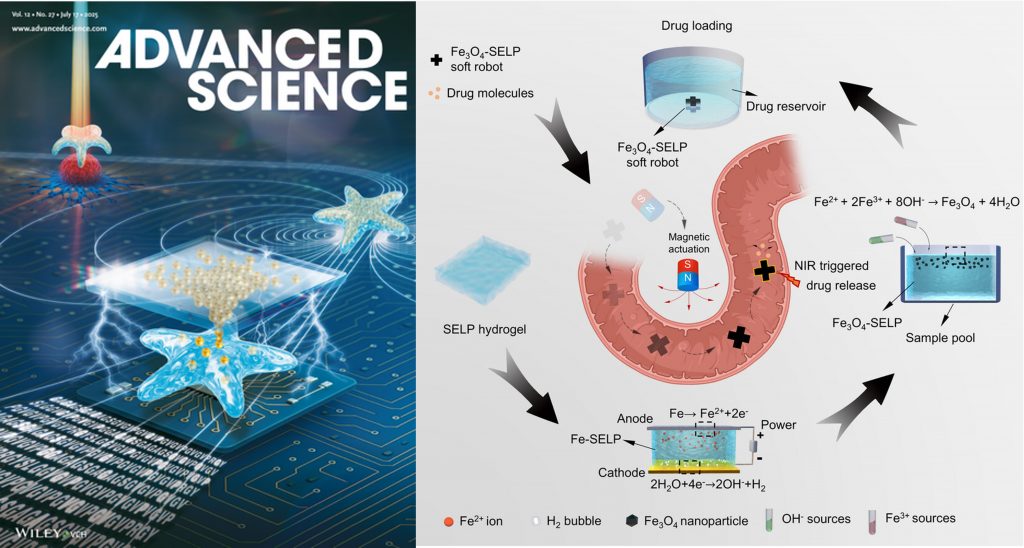
Our lab aims to develop de novo designed protein-based biomaterials, which exhibit changes in one or more properties in response to an external trigger, to address biomedical needs for smart materials. A primary focus of our research is to construct stimuli-responsive yet robust protein libraries of silk-elastin-like proteins (SELPs) using an integrated genetic engineering – modeling approach. Our research also focuses on the functionalization and processing of SELPs using nano and microfabrication technologies, as well as exploiting the stimuli-responsive features of SELPs for applications as novel biomedical devices, including on-demand drug delivery, smart tissue engineering, and soft robotics.
Related Papers:
- Electrochemical-Genetic Programming of Protein-Based Magnetic Soft Robots for Active Drug Delivery, Advanced Science, 2025, 12(27), 2503404. https://doi.org/10.1002/advs.202503404
- Stimuli-Responsive Composite Biopolymer Actuators with Selective Spatial Deformation Behavior, Proceedings of the National Academy of Sciences of the United States of America, 2020, 117(25), 14602-14608. https://doi.org/10.1073/pnas.2002996117
- Design of Multi-Stimuli Responsive Hydrogels using Integrated Modeling and Genetically Engineered Silk-Elastin-Like-Proteins, Advanced Functional Materials, 2016, 26(23), 4113–4123. https://doi.org/10.1002/adfm.201600236
(2) Musculoskeletal Tissue Regeneration
– Development of protein-based biomaterials for novel treatments of the musculoskeletal disease
Musculoskeletal diseases are the leading causes of chronic pain and physical disability, affecting millions of individuals worldwide. Despite recent advances in surgical and medication treatments, it remains challenging to fully restore the function of damaged musculoskeletal tissues. Therefore, designing advanced functional biomaterials, which can provide support, promote healing, and restore function for musculoskeletal systems, has been paid increasing attention.
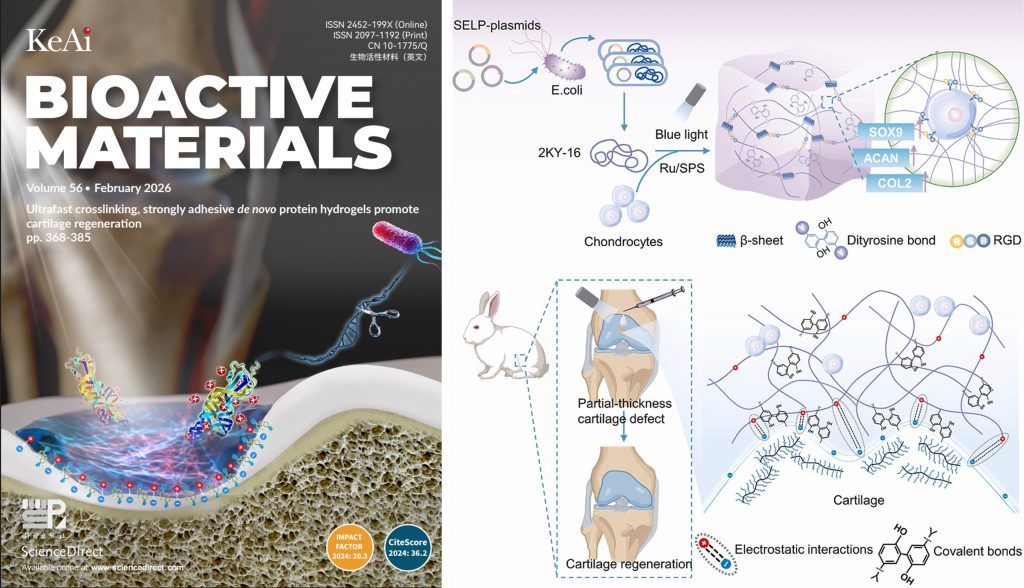
Our lab aims to develop protein-based hydrogels and porous scaffolds to address biomedical needs for novel treatments of knee osteoarthritis (KOA). A primary focus of our research is to synthesize and functionalize silk-based injectable hydrogels for the delivery and recruitment of cells to promote rapid cartilage and bone tissue regeneration.
Related Papers:
- Glycosaminoglycans in tissue regeneration: insights into glycobiology and their biomedical application, Bioactive Materials, 2026, 60, 320-337. https://doi.org/10.1016/j.bioactmat.2025.12.034
- Ultrafast crosslinking, strongly adhesive de novo protein hydrogels promote cartilage regeneration, Bioactive Materials, 2025, 56, 368-385. https://doi.org/10.1016/j.bioactmat.2025.10.009
- Multiscale Design and Synthesis of Biomimetic Gradient Protein/Biosilica Composites for Interfacial Tissue Engineering, Biomaterials, 2017, 145, 44-55. https://doi.org/10.1016/j.biomaterials.2017.08.025
(3) Bio-nanotechnology and Targeted Therapy
– Development of protein design platform and advanced processing strategies for bionanotechnologies
The effectiveness of many therapeutics is often limited by poor bioavailability, lack of tumor selectivity, and an immunosuppressive tumor microenvironment. While nanoparticle-based drug delivery systems have improved pharmacokinetics, achieving precise spatial-temporal control over drug release and combining multimodal treatment within a single, biocompatible platform remain significant challenge.
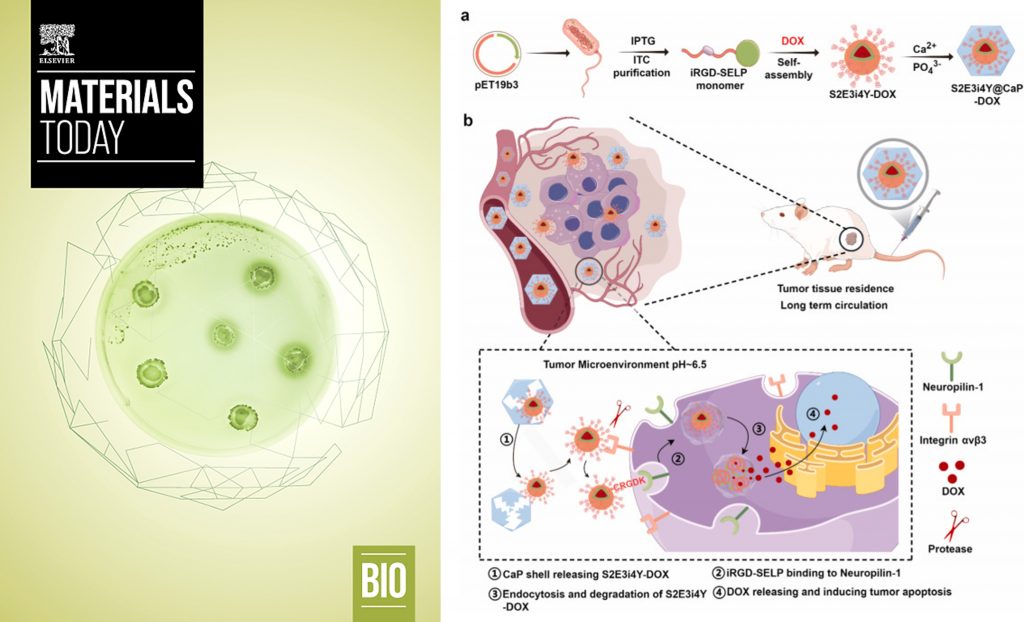
Our lab aims to address these needs by developing genetically programmable protein assemblies as core therapeutic platforms for targeted therapies. We employ de novo protein design and synthetic biology tools to create smart, responsive nanovectors and hydrogels that enhance drug targeting and enable multimodal therapies. Through the integration of modular protein design, responsive material platforms, and advanced fabrication, our research aims to create next-generation bio-nanotechnologies for precise and effective therapeutic delivery.
Related Papers:
- Genetically programmable protein-biomineral core-shell nanovectors for enhancing tumor microenvironment-activated chemotherapy, Materials Today Bio, 2025, 36, 102754. https://doi.org/10.1016/j.mtbio.2025.102754
- Genetically Engineered Light-Responsive In Situ Hydrogels for Immunomodulation and Multimodal Therapy in Metastatic Triple-Negative Breast Cancer, Advanced Science, 2025, 13(3), e12355. https://doi.org/10.1002/advs.202512355
- Synergistic Integration of Experimental and Simulation Approaches for the de novo Design of Silk-based Materials, Accounts of Chemical Research, 2017, 50(4), 866-876. https://doi.org/10.1021/acs.accounts.6b00616